Home / Buying guide
How to choose a portable power station
Size it from what you want to run, not from a product page. Add up the watt-hours your devices use and divide by 0.85: that's the capacity (Wh) to buy. Then check that the continuous output (W) covers everything running at once, and the surge rating covers anything with a motor starting up. Only after that compare battery type, recharge speed, ports, UPS mode and weight. Most bad purchases come from doing it the other way round.
We don't sell power stations or take payment from brands, and we haven't lab-tested specific models. Every figure here is worked out from typical appliance ratings and the maths shown, so you can redo it with your own numbers.
Quick size guide by use
These are worked out with the same rules as our calculator: 85% of the rated capacity is usable through the AC sockets, continuous output is the running watts plus 20%, and the output must also handle at least half of any start-up surge.
| What you want to run | Energy used | Capacity to look for | Output to look for |
|---|---|---|---|
| Phones, a laptop and two LED lights for a day | ~300 Wh | 350 Wh or more | 300 W |
| CPAP, one night, humidifier off | ~280 Wh | About 330 Wh | 300 W |
| CPAP, one night, heated humidifier on | ~600 Wh | About 700 Wh | 300 W |
| Starlink Mini, 24 hours | ~720 Wh | About 850 Wh | 300 W |
| Full-size fridge, 24 hours | ~1,440 Wh | About 1,700 Wh | 600 W continuous, 1,200 W surge |
| Outage basics for a day: fridge, router, 4 lights, phones | ~2,040 Wh | About 2,400 Wh | 1,000 W (surge ~1,300 W) |
| Window AC (5,000 BTU), 8 hours | ~2,400 Wh | About 2,800 Wh | 600 W continuous, 1,200 W surge |
| Sump pump (1/3 HP), 24 hours | ~3,100 Wh | About 3,700 Wh | 1,000 W continuous, 2,000 W surge |
| Microwave or kettle, a few minutes at a time | small | Any size | 1,800 W |
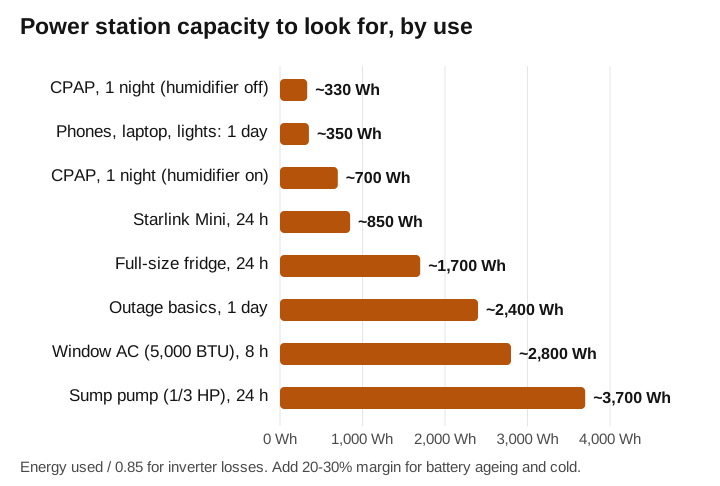
Notice the last two rows. A sump pump needs a big battery and a big surge rating; a microwave barely dents the battery but needs a large inverter. Capacity and output are two separate choices. If that's new to you, read watts vs watt-hours, explained first.
Check 1: capacity (Wh)
Capacity is how long the power station lasts. Work it out from your own list:
Capacity needed (Wh) = sum of (device watts × hours per day) × days ÷ 0.85
The 0.85 covers the energy the inverter turns into heat when it makes AC power. Use each device's average draw, not its label maximum: a fridge rated at 150 W cycles on and off and averages nearer 60 W.
- Add a margin. Batteries lose some capacity as they age and in the cold. Buying 20–30% more than the sum gives you room.
- Plan for the longest gap without recharging, not an average day. For outages that's usually overnight plus a cloudy day.
- DC is more efficient. Devices that can run from the 12 V or USB ports (CPAPs with a DC cable, 12 V fridges, phones) skip the inverter and last longer than this formula says.
Check 2: continuous output and surge (W)
The continuous rating is the most the power station can supply at once. Add up the running watts of everything that will be on together and add 20%. If the total is over the rating, the unit shuts off.
Motors are the catch. Fridges, freezers, sump pumps, window ACs and well pumps draw two to several times their running watts for a second as they start. Look for the surge or peak rating on the spec sheet and make sure it covers your running total plus the biggest start-up jump. Most units surge to about twice their continuous rating.
Heat-making appliances are the other trap: kettles, hair dryers, microwaves, toasters and space heaters draw 900–1,500 W continuously. They need a 1,800 W-class inverter even though they run for minutes.
Check 3: battery type
| LiFePO4 (lithium iron phosphate) | NMC lithium-ion | |
|---|---|---|
| Typical rated cycles to 80% capacity | About 3,000 or more | About 500–1,000 |
| Weight for the same Wh | A little heavier | Lighter |
| Thermal stability | More stable, less prone to overheating | Less stable |
| Where you'll find it | Most current models | Older and some ultralight models |
Cycle ratings are the makers' own numbers, but the gap is real. If you'll use the unit often, for camping every weekend or daily solar, LiFePO4 is the safer long-term buy. The spec sheet usually says the chemistry; if it doesn't, assume NMC.
Cold weather: lithium batteries shouldn't be charged below freezing (32 °F / 0 °C) unless the unit has built-in battery heating. Discharging in the cold is fine, but expect less capacity.
Check 4: how it recharges
- Wall charging speed. Newer units refill in one to two hours; older or cheaper ones can take six or more. For outages, fast charging lets you top up whenever the grid flickers back.
- Solar input. Check the maximum solar watts and the input voltage range. To refill a day's use with about 4 peak sun hours and panels giving 75% of their rating, you need roughly
panel watts ≈ Wh per day ÷ 3. A fridge's 1,440 Wh a day needs about 480 W of panels. - Car charging. A 12 V car socket usually gives only 100–120 W, so it adds roughly 100 Wh per hour of driving. Useful for trips, too slow for a big battery.
- Charging two ways at once. Some units accept AC and solar together, which matters if you need a fast refill.
Check 5: ports and inverter
- Pure sine wave AC. Almost every current model has it, but check: CPAPs, motors and some chargers can misbehave on a modified sine wave.
- Enough AC sockets for what runs together, and at least one that takes a three-prong plug.
- USB-C power delivery wattage. A 100 W or 140 W USB-C port charges a laptop without the AC inverter, which saves energy.
- A regulated 12 V car-style socket for 12 V fridges and CPAP DC cables. "Regulated" means it holds a steady 12 V as the battery drains.
Check 6: UPS or pass-through mode
If the power station will sit at home as backup, look for UPS or pass-through mode: devices stay plugged into the unit, the unit stays plugged into the wall, and it switches to battery when the power cuts. Check the switchover time on the spec sheet; many units quote under 30 milliseconds, which most electronics ride through, but desktop computers and some medical devices are less forgiving. Test it by flipping the breaker while things run.
Check 7: weight, expansion and warranty
- Weight. LiFePO4 units around 1,000 Wh typically weigh roughly 22–30 lb (10–14 kg); 2,000 Wh units can be 40–60 lb. If you'll carry it to a campsite, lift a similar weight before you buy.
- Expansion batteries. Some units accept add-on batteries. If you might want home backup later, buying an expandable unit can be cheaper than replacing it.
- Warranty. LiFePO4 models commonly come with longer warranties than NMC ones. Check what it covers and whether you have to register.
- Fan noise. Units cool themselves with fans when charging fast or under heavy load. In a bedroom with a CPAP, a quiet unit matters; look for noise figures or reviews that mention it.
Is a portable power station worth it?
It's worth it when you need quiet power you can use indoors for a few hours to a few days: a CPAP, a fridge through an outage, internet for remote work, lights and phones. There are no fumes, so it can sit in a bedroom or kitchen, and solar can refill it.
It's not the right tool for running a whole house or heavy loads like central AC or an electric range for days. A gas generator stores far more energy per dollar but must run outdoors, away from windows, because of carbon monoxide. For whole-home backup, look at a home battery system or a standby generator instead.
Five buying mistakes
- Buying on output alone. A 2,000 W inverter on a 500 Wh battery runs a kettle, briefly. Capacity decides how long.
- Ignoring surge. The fridge or pump that trips the unit every time it starts is the most common complaint.
- Using label watts for run time. Use average draw; label maximums overstate how fast the battery drains.
- Forgetting recharging. For a multi-day outage, the solar input and your panels matter as much as the battery.
- Buying the biggest you can afford. Bigger is heavier and slower to recharge. Size it from your list and add a margin.
Ready to size yours? Add your appliances and hours; the calculator returns the Wh, W, surge and solar to look for.
Open the calculatorFAQ
What size portable power station do I need?
Add up the watt-hours your devices use (watts × hours of use) and divide by 0.85 for inverter losses. One CPAP night with the humidifier off is about 330 Wh; a full-size fridge for 24 hours is about 1,700 Wh; a fridge, router, lights and phones for a day is about 2,400 Wh. The calculator does it for your own list.
Is LiFePO4 better than lithium-ion for a power station?
For most buyers, yes. LiFePO4 units are typically rated for around 3,000 or more cycles to 80% capacity, against roughly 500–1,000 for older NMC units, and they're more thermally stable. They're a little heavier.
Is a portable power station worth it?
Yes, if you need quiet, indoor-safe power for a few hours to a few days. For whole-house power or heavy loads over several days, a generator or home battery system stores far more energy.
Can a portable power station run a microwave or space heater?
Only one with about 1,800 W of continuous output for a 1,500 W appliance, and not for long: a 1,500 W heater empties a 1,000 Wh unit in about 34 minutes.
How we worked this out: energy and output figures use typical appliance ratings from our calculator, an 85% usable-capacity assumption, continuous output = running watts × 1.2 (and at least half the start-up surge), and solar at 4 peak sun hours with panels delivering 75% of their rating. Battery cycle, weight and charging figures are typical ranges from manufacturer spec sheets, not our own tests.